 Add to Chrome
 Add to Firefox
 Add to Edge
FedMental: Evaluating Federated Learning for Mental Health Detection from Social Media Data
May 18, 2026
Social media text data are often used to train Machine Learning (ML) models to identify users exhibiting high-risk mental health behaviors. However, sharing this sensitive data poses privacy risks and limits the growth of benchmark datasets. We comprehensively evaluate whether privacy-preserving ML techniques can enable safer data sharing while preserving performance. Specifically, we apply federated learning (FL) and Differentially Private FL for two widely-studied mental health prediction tasks: depression detection on X (Twitter) and suicide crisis detection on Reddit. We simulate realistic data-sharing scenarios by treating each user as a client in a non-IID setting, evaluating across different client fractions, aggregation strategies, and privacy budgets. While FL achieves comparable performance to centralized training (centralized F1 = 85.63; best FL model F1 = 83.16) on depression identification, we find that Differentially Private FL has a large performance-privacy trade-off (up to F1 = 27.01 drop) even with low levels of noise (epsilon = 50). This is due to the distortion of highly informative yet sparse mental health linguistic markers related to mental health, like health topics and emotion words. This research empirically demonstrates the potential and limitations of current privacy preservation techniques for mental health inference tasks.

Secondary Stakeholders in AI: Fighting for, Brokering, and Navigating Agency
Jun 08, 2025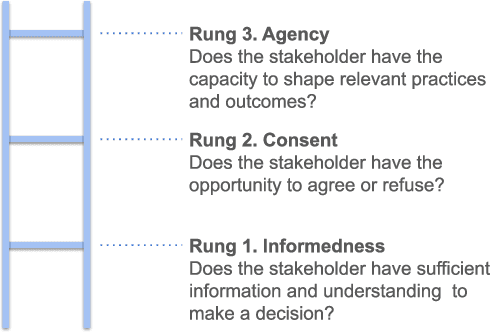
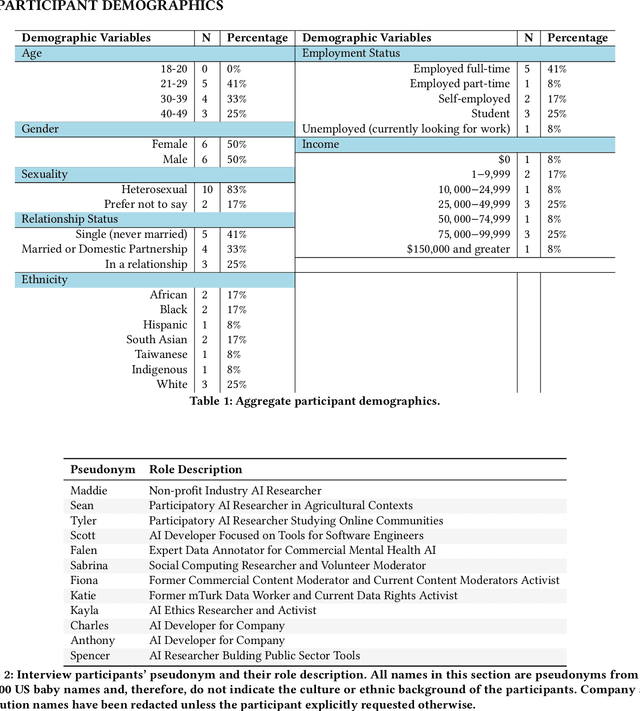
As AI technologies become more human-facing, there have been numerous calls to adapt participatory approaches to AI development -- spurring the idea of participatory AI. However, these calls often focus only on primary stakeholders, such as end-users, and not secondary stakeholders. This paper seeks to translate the ideals of participatory AI to a broader population of secondary AI stakeholders through semi-structured interviews. We theorize that meaningful participation involves three participatory ideals: (1) informedness, (2) consent, and (3) agency. We also explore how secondary stakeholders realize these ideals by traversing a complicated problem space. Like walking up the rungs of a ladder, these ideals build on one another. We introduce three stakeholder archetypes: the reluctant data contributor, the unsupported activist, and the well-intentioned practitioner, who must navigate systemic barriers to achieving agentic AI relationships. We envision an AI future where secondary stakeholders are able to meaningfully participate with the AI systems they influence and are influenced by.